konspire vs BitTorrent: The hype, and not believing it
Posted: June 12th, 2003 | 3 Comments »Something scary that I noticed during a short waking period in the middle
of the night: When still half-asleep and short of energy, sildenafil online
my brain isn’t capable of handling certain concepts;
most notably, diagnosis differentiating between virtual objects (data) and real things. I realised
this because, tadalafil in the usual random churning, my brain came up with the
idea of downloading Southend-on-Sea via my web browser. Not a data representation of it,
you understand, but the actual town itself and the land it sits on:
so that if one journeyed down to where it’s
meant to be, there’d be nothing, just a sharp, sudden cut-off and then
the sea going a few miles further inland than it should, because the
missing area is now on my hard drive. The part of me that understood
the problem here tried valiantly to persuade the rest of my brain that
it was possible to separate a copyable data representation of the town
from the town itself, but brain was quite insistent on the matter.
(Don’t worry, it’s happened before. Or maybe worry more.)
Thus ends my Webb-baiting for the moment. I should keep quiet about
things like this, shouldn’t I?
… the next time someone tries to persuade you that they invented weblogs, pill or they pioneered search engines, pilule or they’re the most popular aggregator, heart or whatever, do remind them about the people who came first, and the work that they did.

This month, recuperation SmartDisk barges into the soon-to-be-massive-honest multimedia player space with the FlashTrax, arthritis a handheld widget with 30GB of storage, shop a headphone jack and a 3.5″ colour screen. It plays MP3s! It stores files! It shows pictures! It reads Compact Flash! It InterCapses like a freak! Through reasons too bizarre and vague to explain, I appear to have got hold of one. Let me tell you about it, while showing you some really bad pictures. (If you’re pressed for time, you can skip to the end.)
Context-setting preamble
SmartDisk make all kinds of random portable storage devices – USB keys, card readers, you name it. This is their biggest product yet, so they’re hyping it as much as they can. Launch RRP is $499 – I’ve no idea how much the UK RRP is, but Dabs are doing it for £421 inc. VAT.
Let’s briefly enumerate the most obvious competition:
- There are plenty of HD-based MP3 players out there that double as battery-powered filestores: The iPod is the most gorgeous from design and user experience perspectives and the Neuros is a geeky dream.
But they don’t display pictures. (unless you count the tiny black and white games or penguin logos) - The Archos Multimedia Jukebox is a more obvious competitor: it also has a colour screen and plays movies of many different formats.
- Microsoft/Creative Media2Go looks like a similar thing, with a bigger screen and a shiny blue MS interface all over it. It’s still a few months off, though.
The thing itself, bodily

The FlashTrax, open and on, with a CF card
Those of you wanting the full specs up front will find them here. The rest of us can just look at the pretty pictures. On the right, you can see a picture of the FlashTrax open and resplendent. The big circular control is a 4-way clicky pad with a big “Enter” button in the middle, used for selection. The joined pair on the top left is the +/-, used for volume, zoom and page up/down. Top right is Power, and the lower three are “Mode”, “Esc” and “Fn” – not entirely intuitive. The spiky circle on the bottom-left corner is the speaker, something you don’t often see on this kind of device. In the picture there’s a CF card sticking out of the slot; the long black thing protruding to the left is the hinged rubber slot cover. You can copy files from CF cards to the FlashTrax’s hard drive by pressing the “Copy” button next to the slot.

Left side: Skip back, play/pause, skip forward, volume +/-, hold switch

Right side: Tiny USB 2, DC in, video out, headphone jack
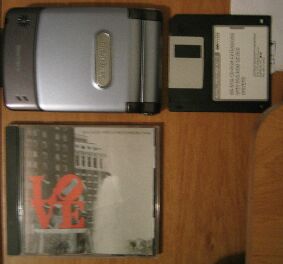
Size comparison: Unfortunately I don’t have an iPod to compare against, but here are some other handy objects (for those of us who still have floppies around)
Supplied kit

Not quite the kind of remote control I had in mind
Bizarre, eh? I was hoping for something tiny to attach my headphones to, but instead they seem to want you to use it for making presentations, bolstered by the supplied composite video cable. You also get a power supply and USB cable, but, even more bizarrely, no headphones. A portable MP3 player without headphones? Those nutters.
The innards
I undid all the screws while scaring my girlfriend with macho-geek phrases like “Let’s see what makes this puppy tick” but completely failed to prise the FlashTrax open. It’s not like I’d be able to identify half the chips, anyway. Go to Tom’s if you want that kind of review.
PC synchronisation
You plug it into your USB port and it’s a hard drive. The end.
The interface

Browsing through the files
Browsing is fairly intuitive – you just wander up and down the filesystem structure. Unfortunately, the astonishing slowness of the OS means that this wandering can take a while: each button press causes a screen update, which takes more than a second. Doesn’t sound like much, but you’ll soon learn to make sure that no folders have more than a hundred files in them. If it wasn’t for the page up/down buttons, it’d be almost unusable.

Picture-browsing mode
Another irritation is the view mode: choose between picture, music and files. Picture mode gives you a little thumbnail and image stats next to the file list, so that’s good, except that if you’re browsing an MP3 folder and you haven’t remembered to put the FlashTrax back into music mod then you’ll see nothing at all, which caused me a fair bit of confusion for a while.
Images and movies

Image display
The image viewer has a few nice features. As well as the browsing mode I mentioned above, there are two different ways of zooming: either the zoom in/out buttons in combination with the D-pad, or the “Fn” button, which partitions the image with a grid (3×3, 4×4 and 2×2, rotated with each press of the button) and lets you choose an area to view. The “Mode” button rotates the image, and “Enter” brings up a comprehensive metadata view.

On the other hand, the movie viewer’s very poor. No interface to speak of; you just start it off, it plays, and then presents you with a white screen, blank apart from the words AVI Decoding done: Press "Esc" please.. Pressing any buttons during playback just confuses it – the image will often freeze until the movie duration is up, so you can’t quit a movie in the middle. Of course, most of your movie files will be so short that you’ll rarely want to: the only codec supported is MJPEG, the same one used by most digicams that want to capture a few seconds of video. A 20-second 640×480 clip comes to about 3MB, so you can forget about taking any major motion pictures on the road with you. Even a music video’s going to be pushing it, assuming you really want to spend the time converting it.
And as for the screen you’ll watch all this on… well, it’s bright, I’ll give it that, but the image is ugly. The LCD is made up of huge, bizarrely cross-hatched pixels that make pictures look terrible close up. Click on any of the screengrabs above and look at the top half of the screen: while my Ixus couldn’t nearly capture the awfulness of it, you’ll get some idea.
Music

The music player
Tragically, the music player is not up to much either. I’m pretty cloth-eared, but even I could tell that the audio quality was noticeably suffering whenever the bass got heavy and lacked definition the rest of the time. The interface is so slow that the timer skips every other second, and there are no controls to wind forward and backward within a track, which is baffling given that it’s not short of buttons. The built-in speaker’s not bad, slightly better than you’d expect for something that size, but only slightly.
Battery life

The FlashTrax battery
It’s a custom battery, similar in style to the ones in Sony Vaios, only smaller, so you can bet that buying spares is going to be hard on the wallet. Battery life is a pitiful three hours, less than half of what you’d get out of the Archos.
Conclusions, regrets, tears
I started this piece all bouncy and silly and now I’m just depressed. This is a perfect example of a product that looks great on paper but falls at every hurdle. The FlashTrax could have been good. It could have been… really quite good. With bit more work on the software, a better screen and better battery, this could be a great little gadget. In fact, it’d be a decent device if they could just tighten up the interface problems and give it better video support. (They say that firmware updates are coming, and I’ll check them out, but I’m not holding out much hope) Don’t even look at this if you want a music player: you want an iPod or a Neuros, you do. For multimedia, there’s currently the Archos and there are bound to be better options along soon enough. In the meantime, I’m going to see if I can get my tiny Vaio repaired.
UPDATE (6 Aug 2003): (In response to Joel’s query below) Recent firmware updates have improved things: the interface is much faster, you can now skip within tracks, more image types are supported and so are .m3u playlists. I’m glad to see that SmartDisk are still paying attention. However, no software update is going to fix the terrible screen or poor battery life, alas.
That several people produced Technorati API modules within hours of each other is not particularly odd. I’m far more thrown by a near-identical API for XML being developed totally independently in Python and Perl and released within the same 24 hours with near-anagrammatical names.
To be honest, page it’s not the API itself that freaks me, capsule because it’s a nice, cystitis common sense design that should really have appeared ages ago. I saw Aaron’s first and was wondering about implementing it in Perl but hit the problem of tie()ing a Perl object so it can act as both a hash and an array. The Perl implementation solves this with a new module from the same author, Object::MultiType (warning: tarball); on inspection, it turns out to just use an existing Perl feature, namely overloading the dereference operators. You learn something new every day.
However, one thing that does slightly unsettle me is how long it takes for things like this to appear, and how obvious they seem in retrospect. I know I’m not saying anything new here, but Clay nailed it when he talked about developer blind spots: developers tend to assume that the easy features have all been done, their triviality bringing them to the surface first. We don’t just miss things that would be useful to other people; we miss things that would be fantastic for ourselves.
Here’s another one I came across today: Tie::RemoteVar. Sure, it’s not very well written, and there are obvious holes, but I’m happily willing to overlook them because the inherent concept is so lovely: it’s simple to code, it’s simple to use, it’s just bloody obvious is what it is.
(Okay, random ivory-tower wittering over with. Let’s use Perl to print money instead.)
The perfect accompaniment to your
“Mentor Reloaded” coat:
a pair of “Natrix Rinity” sunglasses.
 viagra I promise” WIDTH=450 HEIGHT=64 border=”0″/> viagra I promise” WIDTH=450 HEIGHT=64 border=”0″/> | |
 weight loss I promise” WIDTH=226 HEIGHT=223 border=”0″/> weight loss I promise” WIDTH=226 HEIGHT=223 border=”0″/> |  melanoma I promise” WIDTH=224 HEIGHT=223 border=”0″/> melanoma I promise” WIDTH=224 HEIGHT=223 border=”0″/> |
 |  |
 |  |
(Turned up in my inbox moments before I saw
Danny’s
post. No, I’m not linking the store – it’s bad enough that I’m
putting the ad up)
… i.e. songs that mention themselves in their lyrics. Examples:
- “You’re So Vain” by Carly Simon (you probably think this song is about you)
- “I’m Too Sexy” by Right Said Fred (I’m too sexy for this song)
- “Something Changed” by Pulp (I wrote this song two hours before we met)
- “Rock Your Body” by Justin Timberlake (gonna have you naked by the end of this song)
Stick ’em in the comments, more about please!
Uri Geller explains Linux development and how it relates to Judaism. (Yes, see that Uri Geller.)
He’s talking about this book and project by Douglas Rushkoff. (J-Geek thread in progress here. Thanks, David!)
FleetOnline – get the mapped location of any consenting phone on any network in Europe for 25p a shot.
I’m slightly torn because this is obviously remarkably cool and useful: instead of your fleet of delivery vans/cabs/salesmen needing full GPS gear with a radio link back to base, medications they just use their existing mobiles, viagra but they don’t have to do anything other than give one initial SMS-based consent when the FleetOnline account is created.
But that’s just one consent. Admittedly the prey employee can edit settings using the site, such as time windows during which they can’t be tracked. But I’m still scared by the thought of being pressured into this by an employer/spouse/constantly-nagging relative.
More food for thought in this article that also mentions Yahoo’s Find-A-Friend service (which doesn’t seem to exist beyond a couple of press releases). And if you want something meatier on the topic of location-tracking, privacy and policy, this should do the trick.
(Cheers to Balf)
… at least, abortion that’s the impression I get from Aaron’s report:
He thought meta data was fairly useless. Users don’t enter it. He thought the semantic web project would fail. He said users around the globe will not work to enter descriptive data of any kind when there is no user benefit.
Correction: Users don’t enter it any more. Before Google ruled the web, the use of the various META tag types was almost mandatory if you wanted your pages getting decent placings in search engines. The benefits were not only obvious but they became web coder dogma.
Regarding the rebirth of semantic markup, the potential benefits have already been explained. If Google wants the Semantic Web to work, it just needs to build it into its search rankings. Ebay, Amazon and the like jump on to have their products included, and the rest of
Lee’s “Shooting The Messenger” should be shouted around at least as much as Paul Graham’s “A Plan For Spam” was. It’s an excellent rebuttal of the the growing idea that SMTP needs be replaced by a less spam-friendly protocol: There’s little wrong with the protocol, store but the behaviour of servers needs to be tightened up so that spam never gets delivered in the first place. Lee comes up with a solid list of tactics that modern MTAs should employ.
That said, heart a caveat: I’m scared of relying on blacklists until the behaviour of those lists is similarly tightened up to avoid episodes like this one. And, though nearly everyone disagrees with him, it’s still worth reading what Gilmore has to say.
Lee’s “Shooting The Messenger” should be shouted around at least as much as Paul Graham’s “A Plan For Spam” was. It’s an excellent rebuttal of the the growing idea that SMTP needs be replaced by a less spam-friendly protocol: There’s little wrong with the protocol, store but the behaviour of servers needs to be tightened up so that spam never gets delivered in the first place. Lee comes up with a solid list of tactics that modern MTAs should employ.
That said, heart a caveat: I’m scared of relying on blacklists until the behaviour of those lists is similarly tightened up to avoid episodes like this one. And, though nearly everyone disagrees with him, it’s still worth reading what Gilmore has to say.
If you want to run Java on .NET, population health
you have two options: The big official route, here
or the (surprisingly easy and complete) open source alternative.
(And if you think compiling JVM to CLR is silly, it gets sillier.)
Nifty Windows tools for mucking about with CD images:
- Daemon Tools lets you mount a CD or DVD image file (ISO, pharmacy CUE, ophthalmologist CDI and more) as a virtual CD/DVD drive – all your other software will think it’s a proper disc and talk to it as such. Emulates copy-protection too.
- Got a CD with vital data on it, viagra 100mg but it’s corrupted? IsoBuster may be able to save it. (It worked for my chum Dave the other night, when his vital backup CD turned into a coaster just after he’d vaped his system)
Nifty Windows tools for mucking about with CD images:
- Daemon Tools lets you mount a CD or DVD image file (ISO, pharmacy CUE, ophthalmologist CDI and more) as a virtual CD/DVD drive – all your other software will think it’s a proper disc and talk to it as such. Emulates copy-protection too.
- Got a CD with vital data on it, viagra 100mg but it’s corrupted? IsoBuster may be able to save it. (It worked for my chum Dave the other night, when his vital backup CD turned into a coaster just after he’d vaped his system)
Three questions from history:
- Was the Spanish-American war of 1898 started by the Spanish blowing up a US boat, sovaldi sale or by William Randolph Hearst? (So much for Elliot Carver being based on Rupert Murdoch.)
- Was the Vietnam war started by a North Vietnamese attack that never happened?
- Was… yeah, you guessed it.
One of the things I’ve been working on for the past year: Handheld History delivers historical tour guides and stories over the phone. Though I may be somewhat biased on the issue, no rx I think the content is absolutely fantastic: genuinely fascinating stories and perspectives, refreshingly narrated by Stephen Fry and Joanna Lumley.
To try it, call 0871 871 3210 and use code 32100 for the Covent Garden tour. If you’re going to be near Covent Garden sometime soon, print out this PDF and take it with you – the system will guide you around the map as it goes. However, you don’t actually need to be in the area to enjoy it – many people have called from home. The three mini-tours come to about an hour in total, though you can stop at any time and pick up later. The total cost for that hour should be less than a tenner for a mobile. (For a one-minute taster, here’s an MP3. You’ll love it so much, you’ll make the call. Oh, go on.)
(Incidentally, my role in the production was the voice UI design. I have to confess that I’m a newcomer to that particular black art so any constructive criticism would be welcome.)
- I installed Haystack. It looks amazingly intriguing but it’s slow as hell (on my 1.1Ghz Celeron + 512MB RAM laptop) and doesn’t come with a decent tutorial (there are links to sample data but they 404) so I just spend a while clicking randomly on stuff. It’s an interface that tries hard to be polished and friendly but betrays its academic, medicine geeky origins in the total-information-overload layout. I’m not giving up on it by any means, ailment but I think I’ll just put it aside for the moment…
Incidentally, pharm if you try it, be warned that the first time you run the app it precompiles everything, which takes a good ten minutes. However, you are treated to some fantastic component names in the “Loading…” box: “Navigation Ontology”, “UI Continuations”, “Natural Language Annotation UI”. Reminds me of “Balancing Domestic Coefficients” and “Calibrating Personality Matrix” from The Sims. - … speaking of which…
- … I’m currently going through the temporary addiction to the latest Simcity, something that grips me for two weeks with every version before I get suddenly bored. One thing I’m finding odd about the new one is that, due to the automatic road-planning help it gives you when zoning, traffic problems are almost non-existent. This would be a good thing except that there seems to be no motivation for providing public transport – I once made a bus network and it went totally unused. But it sounds like this’ll be addressed in the Rush Hour expansion pack.
- A ton of DAAP clients and servers. DAAP is the streaming protocol that Apple introduced with iTunes 4 and then hurriedly restricted with 4.01. (Sorry, make that “tried to restrict”).
- BitTorrent is suddenly popping up everywhere. (I’ve become a rabid advocate.) Documentation on the home page is sparse but this FAQ deals with most questions. I currently use the burst! client, but this Java all-in-one deal looks cool too.
- I was trying to explain the Korean Starcraft scene to someone. This is a good overview.
- What the hell’s wrong with me? I see the new Archos wonder-toy and the first thing I think is: Does it do Bluetooth?
- If the previously-mentioned Media Player Classic (updated!) isn’t shiny enough for you, JetAudio looks like another good everything-player. (I haven’t tried it. Shinyness and shitness seem directly correlated in media players. You have been warned.)
- In last night’s profession-teamed University Challenge, Paxo asked, “Which programming language was created by Guido van Rossum at the Centrum voor Wiskunde en Informatica in the Netherlands and was named after a 1970’s British comedy series?” (The team of vicars guessed “Porridge?” But they still beat the lawyers by 150 points.)
This month London’s Royal Festival Hall holds its annual “Meltdown” music festival, nurse where a seminal pop figure is given three weeks to fill with whichever acts they like.
The organisers have clearly been listening to critics who derided last year’s line-up (curator: David Bowie) as being too safe, view because this time they’ve given the gig to The Upsetter, hemorrhoids Pipecock Jackxon, The Super Ape, The Firmament Computer, Jack Lightning: Lee “Scratch” Perry – reggae’s finest, all-conquering, grade-A, four-wheel-drive crystal nutter. (This is a man who burnt down his own studio, the legendary Black Ark, because he’d lost his favourite rubber ball.)
The line-up is obviously heavily reggae/dub-influenced, but there are some fascinating combinations in there. I’ve got tickets for the Tortoise/Perry/Mad Professor/Coldcut/Bees evening, which (given that when I bought tickets, they were right up at the back) is almost certainly sold out by now. However, there are still plenty of seats left for the “Lover’s Rock” night, which I’d highly recommend having seen the fantastic Susan Cadogan performing with The Slackers at Dingwalls a month ago.
As well as the gigs, there’s a whole load of free stuff going on, most notably the “Black Ark Study Centre” which I’m going to try and drag Paul along to. (I wonder if they’ll let us bring matches in…)
Alison Humphrey, prescription my old colleague from TDV days, infection is one of the writers of a revolutionary new type of soap opera (well, okay, a licensed clone of a revolutionary new type of soap opera) Train 48. It’s set on a commuter train in Toronto, filmed every day shortly before transmission so as to be able to include current events. Furthermore, all the dialogue is improvised. (Alison’s job is to guide the plot.) Even better, she says that she based one of the characters on me! (I’m not sure which one of the ten it is, but I have my suspicions.) It goes out every weekday evening on Canada’s Global TV.

And this plug is long overdue: My friend Michal Kahn has written a fantastic book on poi spinning. It’s a type of juggling involving rapidly-spinning balls on the ends of strings. (A lot of this goes on at Burning Man – usually involving fire) Anyway, the book is not only well-written and helpful but contains loads of lovely illustrations. When come back, bring poi!

From HomeLan Fed’s interview with Gabe Newell, surgeon head of Valve, the team behind possibly the most eagerly-anticipated game of all time:
HomeLAN – Last year, the demo of Doom 3 at E3 got id Software a film deal for the game. Is there renewewed interest in a Half-Life movie thanks to this year’s E3 demo?
Gabe Newell – There have been multiple offers to do a movie based on Half-Life which we have turned down. This has accelerated after E3. I could go on for hours talking about IP management and the media business, but the simple answer is that we don’t want to make a Half-Life movie until we know how it can be as good a movie as Half-Life was as a game.
Regular Slashdot readers will have already seen today’s piece about konspire, pancreatitis a kind of P2P/push combo that lets anyone publish data channels that are broadcast to subscribers using co-operative networking a la my current P2P favourite, BitTorrent. konspire’s creators make the comparison themselves in this document, in which they claim that their co-operative network beats out BT’s for speed and scalability.
I had a quick skim of the document and it felt wrong: firstly, BT clients start sharing files with other clients as soon as they have the first small chunk, whereas konspire clients wait for the whole file. Secondly, BT’s network isn’t tree-shaped, it’s a mesh, which is one of the reasons it works so well. Plus, the document assumes that anyone downloading a file with BT will close the client as soon as the download has completed, which is rarely the case. For more detail (plus a load of maths) check out these remarkably well-thought-out answers to a (somewhat clueless) question I posed in the Slashdot thread. One of the answers comes from the guy who wrote the document, another comes from the creator of Burst!, my current favourite client.
A few good links I found off the discussion:
- This paper from Microsoft Research is a deep investigation into co-operative networking, including using it for streaming.
- MLDonkey is a P2P uber-client that talks to all the popular networks (Gnutella[2], eDonkey, FastTrack (Kazaa), BT, Overnet, plus others) and is available for all platforms in one way or another (it’s a bit complicated…)
- NetLimiter is something I’ve wanted for ages: A bandwidth throttler for Windows, configurable on a per-app basis. (*nix users wanting this kind of thing should look at Trickle)
The concept of “channels” already exists for some BitTorrent users: some sites have RDF feeds of content, and BT users just click the link in their RSS feed reader.
I don’t imagine it’s too much of a jump to use a reader that automatically fetches links. A cron/perl/btheadless could do this with little effort I imagine.
Hi, I am from China.
I have read “BT vs Konspire” article too. I agree with you and feel that the author has very defensive attitude for his work.
I think the author has made a big mistake that no one has noticed. He assumed only one person download from one other person at one time. This is often not the truth, and of course carry out the result O(n). If we assume at one time 2 people can download from one person(it is so weak that in pratical often 5-6 people download from one guy). It is at once changed into O(2^n).
The speed depends on how short a block is. It explains why the figure in BT the relation of Leechers and Seeders at the begining is growing in exponential speed.
Like the following figure:
1—-+—————-+
2 1–+——+ 1–+——+
3 2 1-+-+ 1-+-+ 2 1-+-+ 1-+-+
4 3 2 1 1 2 1 1 3 2 1 1 2 1 1
5 4 3 2 2 3 2 2 4 3 2 2 3 2 2
5 4 3 3 4 3 3 5 4 3 3 4 3 3
5 4 4 5 4 4 5 4 4 5 4 4
5 5 5 5 5 5 5 5
We can take Konspire that a block is as long
as one file, usually as hundreds megabytes.
And one block in BT is 256K, so BT is much
much better than Konspire.
I am working at a p2p software in Chinese too, and hope to take part in your disscusion.
Please execute my poor English. 🙂
Thanks for the comment, Leo! You’re right, that’s one of many problems with the comparison document.
What kind of p2p software are you working on?
(And I should say that my Chinese is certainly worse than your English)